
There are Five Phases to your Landscaping Journey
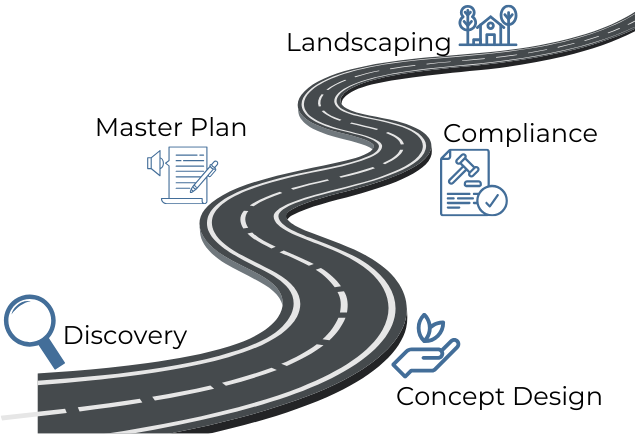
Of the five phases, the Discovery Phase is predominately done by you.
This article is going to talk about what you go through, how to set realistic expectations and how to avoid the pitfalls that come with a lack of knowledge.
The Discovery Phase
Your ‘why’ for embarking on this path can be for many reasons. Perhaps you are building a new home and the surrounding land is a blank canvas in need of a garden. Perhaps you gaze out of your window and see a garden no longer inviting as it once was. Or, maybe there was a moment you sat contemplating what life would be like if you had an inviting garden others wanted to spend time in with you. Whatever your initial driving desire, you have entered this phase and are now questioning what you want and how to get there.
This phase begins with you doing all the work and only later does the baton get handed over to a designer to expand upon the ideas for your consideration.
Let’s now place a magnifying glass over the above diagram and see what makes up the discovery phase.
As we already mentioned, the Initial Contemplation is what drives this desire, but it is the next step where you do the heavy lifting of ideas to consider.
Imagine-Research-Define
It is likely that this is the step you are on at the moment, whether just starting or near the end. What is important to know is that these three steps are a revolving aspect that you go through again and again. You will revolve through this many times yourself and again with your landscape designer.
You begin with defining the garden elements that you want to include in your garden. This begins broadly with such elements as, a pergola area, a pool, a path to the front door, etc. It may be more conceptual, “I’d like a Hamptons-looking garden.” You may define it in terms of functionality, “the kids need an area to play basketball”. This step is all about the ‘wants’ and the creation of a wish list. Some might refer to it as the dreaming stage.
While defining what you want, you imagine your future garden with these elements in it. Contemplation of how it all may look and function, allows you to keep or discard elements and helps narrow in on deciding what you want.
And of course, researching landscaping ideas is where you will probably spend most of your time. Where should you research? Pinterest is a great tool online for collecting images, as is Houzz. Visiting friends and discovering what you like and don’t about their garden helps. Another great way is to visit gardens that are part of an Open Garden Scheme. This is where a designer asks the homeowner to allow the garden to be open to the general public so they can show off a garden they have designed and/or built.
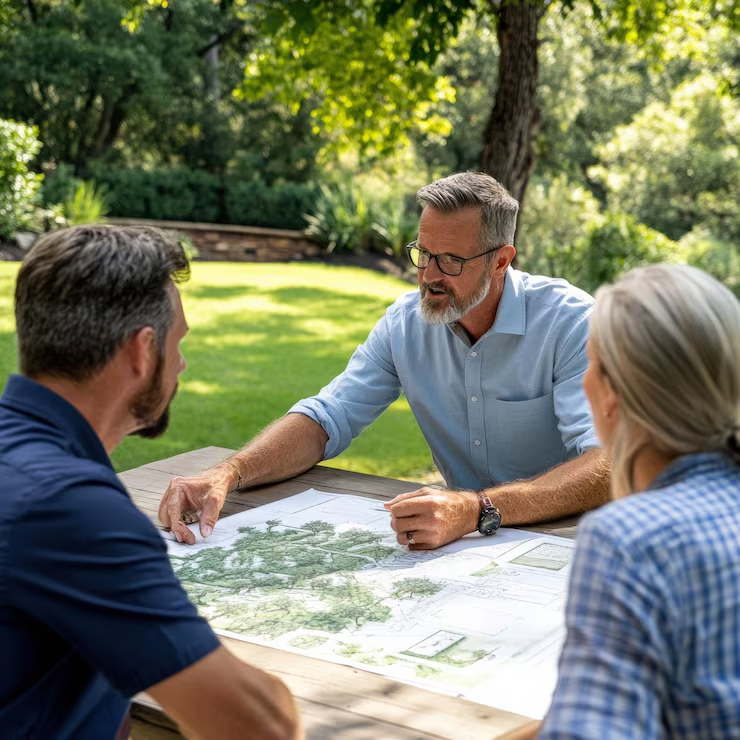
During this stage, at some point, you usually decide to reach out to a designer. The most common words people tell the designer is, “I know what I want but not sure how to put it all together.” Knowing, “How to interview a designer” and “How to engage the right landscape designer” are two critical aspects that will determine the successful outcome of your project.
A Tool to help with the Imagine-Research-Define stage
We have developed a tool to help you see where to focus your attention as you go through the cycles above.
As you revolve around this wheel, consider these four aspects:
- Functionality – How do you wish your garden to perform? What are the kids needs? How many guests do you wish to entertain? Do you want a Pool? Etc.
- Partnerships – Do you need a designer, landscaper, building surveyor, pool builder, kitchen installer, plumber, etc? Do you want someone to project manage all this, i.e. Designer, a Landscaper, Or a business that does both?
- Aesthetics – what do you like to look at? Do you want fragrance or the sound of water? What style of Planting do you like? Think of all the aspects that appeal to you.
- Wellbeing – Ultimately this is the real reason for doing any of this, so the question is, How would you like your garden to impact your wellbeing? This comes down to four urges to be satisfied;
- To elevate your state of being, what would your garden need to be? And what would be the flow on effects for the rest of your life if you achieved this?
- To have a space where the family connects and shares moments that strengthen and elevate the bond and provide times for fond reflection in later years.
- To connect with others. Social Wellbeing is a strong motivating force that brings meaning to living. It is why people place great emphasis on the ‘entertainment’ aspects in the landscape designing phases.
- And this last one comes down to the awareness of each individual, it is connection with nature. Our modern living sadly, disconnects many from this immense opportunity for wellbeing. I am not talking about gardening. Plants and other life forms are our cousin. They have the same life energy as we do and can share it with us. If you wish to understand more on this, The Royal Botanic Gardens in Melbourne wrote a great article on this titled, Nature for Health & Wellbeing. In summary, with careful planning, the plants in your garden will contribute to your wellbeing.
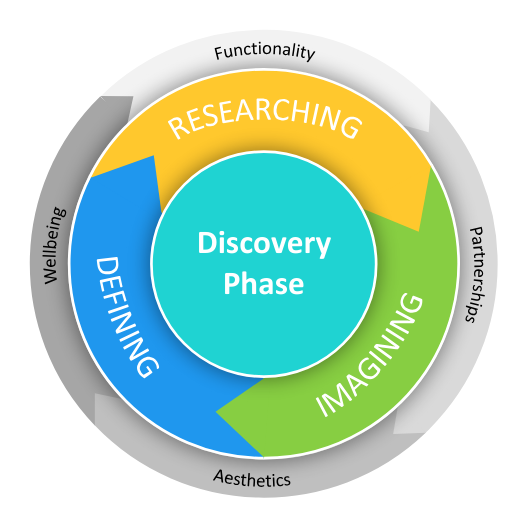
The most important thing for you to know is this, as you cycle through this whole wheel many times you are Evolving & Crystalising your dream and the more times you cycle through the more clarity you gain.
Passing the baton to your designer
Once you have engaged a designer it is their turn to cycle with you as above. The result you are looking for is to formulate the brief. If you would like to get a clear definition of what a brief is, see the Wikipedia link here, Wikipedia brief defined – But to complete the brief we need to discuss another step…
Feasibility Stage
The question of feasibility is often back of mind throughout your journey. Once you know what you want, feasibility may become a barrier to moving forward until it is resolved. Often, this is a point where you contact a designer and discuss your ideas to:
a) Find out if what you want is possible with the space available, practical, etc.
b) To get an idea of what it might cost
The Discovery Wheel never really stops revolving. Even as late as being in the middle of landscaping, a client might announce “I just came across… and was wondering if we should include this too?” – So, Imagine-Research-Define and feasibility are a constant throughout your journey.
It is worth mentioning here a commonly spoken question, “How much will landscaping cost?“
The short answer is, an experienced designer should be able to guide you on this. The longer answer requires reading our blog, How much will landscaping cost?
Engaging the right designer
Why people engage one designer over another is varied. When assessing if a designer is a right fit for you, consider the following points:
- The experience of the designer in relation to the complexity of your project.
- Does the designer have a personal bias toward particular styles of garden, and is the style one you like?
- Do they have the same reality as a landscaper when it comes to materials i.e. will the landscaper say, “We can’t build it the way it is designed”
- Their understanding of compliance matters and do they have enough experience?
- Are they linked to other landscapers they can refer
- Do they offer to work with you all the way through to the completion of landscaping
- How detailed are their plans
- What is their plant knowledge
- Is the designer and landscaper part of the same company and is this an advantage to you
- Do you trust and like them, as this is important
In Summary
The tools on this page when applied, will reap greater results.
The key takeaway should be that this phase is ‘cyclic’ and you will likely revolve many times to allow ideas to evolve.
Our design team are expert guides with experience in working with over 500 clients.
Please use the following link to find out what our Discovery Consultation involves and if it would help you reach a better conclusion.
What is a Discovery Consultation?