
It’s well known that a lot of Melbourne’s house blocks are just not flat. Many slope to the front, back, or one side. Many others were cut and filled when the house was originally built and have been quietly moving ever since. Over the past 35 years, it seems like almost every garden we’ve desigend has needed at least one retaining wall. Some needed 2, 3 or even 5!
Now a retaining wall is rarely something a client will actually ask for. I can’t think of anyone who has ever rung us wanting one. What they do want however is a flat lawn, a level terrace for the table, or a pool that does not sit down at the bottom of a hole. And it’s a retaining wall that makes all these things possible. But because it is a garden element that nobody actually says they want, it is often subject to wrong or ill-considered decisions. Like wrong materials, wrong construction methods or simply too much being spent on a wall nobody will see, or too little on one that has to hold up the entire garden.
When it comes to retaining walls we tend to think in 4 different solutions
The four most common retaining walls we use in Melbourne
Concrete sleeper walls. A very popular choice. Essentially these consist of steel posts set in concrete, with precast concrete sleepers dropped in between them. Concrete sleeper walls are strong, quick to build, and cost a fraction of one made of stone or brick. But they are also not much to look at. We use them frequently, but almost never where you will see them. If you build a concrete sleeper wall, set it well back, with plants in front of it or screened by a hedge or a layer of shrubs, it can do a brilliant job of holding a slope back for a reasonable price. But only so long as you put something much better looking in front of it. Putting one next to your outdoor dining table however, where it will be visible all the time, is definitely the wrong place.
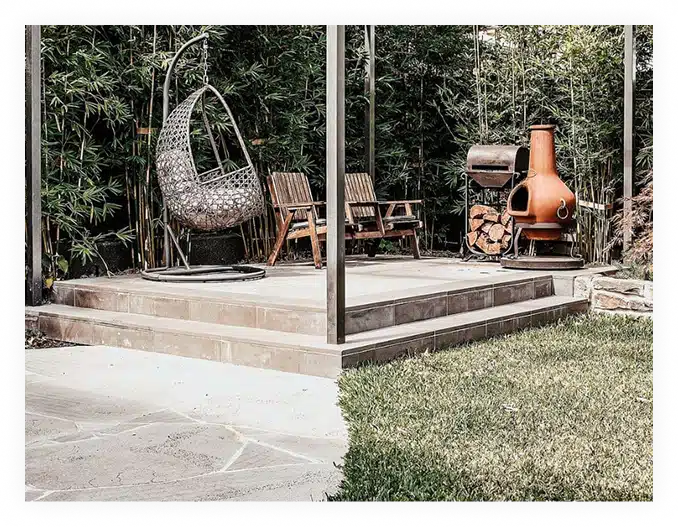
Concrete block walls, rendered. These are considered the “workhorse wall” of the visible garden. Concrete blocks laid on a footing, core filled, then rendered and painted. Clean and solid, these types of walls feature a surface that can be any colour the designer or client needs. This is usually the wall you will find around the pool, behind seating, or forming the terrace you will look at every day. It costs more than a concrete sleeper wall because every part of it is done by hand. And because it needs proper footings with full drainage behind it. But this is wall you will be happy to see and not be put off by it. In fact, done right, it can look great.
Concrete block walls, stone clad. This wall has the same structure as the previous one but with a very different face. Instead of being rendered and painted, the wall is clad in natural stone: Castlemaine slate, Gosford sandstone, bluestone, whatever suits the house. It is the most expensive of the four wall options, but it’s the best looking; because it looks like a real stone wall. It should be used where the wall will be a feature in the garden, but nowhere else. Cladding a wall in stone and then hiding it behind a hedge is a waste of money, because no one will get to enjoy it.
Gabion walls. These are steel mesh cages filled with rock. While they started life being used on highways and riverbanks, they have become more popular for gardens because they look honest and they drain themselves. Water passes straight through the gaps between the rocks, so the drainage problems that plague many solid walls largely disappear. But they are heavy, take up more room than a block wall of the same height, and the look only suits some houses but not others. In the right garden however (usually something contemporary or something rural) a gabion wall is hard to beat. But use it in a period garden in Malvern and it will look like it wandered in from a nearby freeway and decided to stay.
When and why you might need an engineer for your wall
A low wall that only has to hold back a garden bed is one thing. But a wall that must hold back 1.5 metres of earth with a pool sitting in it is a entirely different structure. It’s no longer just a landscaping decision. It’s become an engineering one.
In Victoria, any retaining wall over 1 metre in height needs a building permit. Now some councils may even require a permit for a lower wall if it will be close to a boundary or holding something up. Any permit for a retaining wall means a structural engineer has to design the wall including specifying the footing it sits on, the type of steel used, the drainage system, the lot. Naturally this will add cost and time, which can surprise many clients. But a wall that fails because it hasn’t been properly engineered can take down a terrace, a fence and sometimes the neighbour’s garden with it. So calling in an engineer will always be cheaper than letting that happen. If your garden design has a wall higher than a metre, assume it will be need engineering and plan for it right from the start. Not after your landscapers’ quote.
Drainage ultimately decides if a wall is going to last
Draining is the part of a wall that most often gets skipped over. But it’s the part that matters most. Because it alone determines if a wall will last or fail.
Soil holds water. Lots of it. After a week of Melbourne rain, the earth behind a retaining wall can become incredibly heavy. It pushes on the back of the wall with a force most people would not believe. A wall designed and built only to hold dry soil will not be able to hold back wet soil. It will lean, crack, and eventually fail. (Usually just a year or two after the warranty has expired or the landscaper has moved on!)
So behind every solid wall we build at Whyte Gardens there is always a drainage layer. Drainage gravel or scoria is laid against the back of the wall, with an agricultural pipe laid at the base to take the water away to the nearest legal discharge point. We also install a waterproof membrane behind the wall so the water does not seep through to the wall itself. You will never see any of all this once the wall is built, but is the most important part of it. A retaining wall quote that does not mention drainage is not a quote for a retaining wall. It is a quote for a pile of blocks or sleepers. Because without proper drainage that is what your wall will eventually become.
The secret to the right retaining wall? Spend where it shows, save where it does not
Of the 4 most common retaining wall types, which is the best one for your garden? Surprisingly, often a garden will need more than one type of wall for different purposes. Since they are not all equal in cost and aesthetics, rather than choosing the same type for every part of your garden, it’s best to chose each one based on its fitness to the task.
So the one you will see every day from the kitchen window is worth being rendered and painted or clad in stone. (The most expensive style). But the one at the back of the block, that will sit behind the hedge, and hold up the neighbour’s garden, can be a less expensive concrete sleeper wall and nobody will ever know.
A good landscape designer will make these decisions early on in the process, wall by wall, before anything is priced. Your money will be spent where it will be seen and held back where it won’t. That is how you create a garden on a sloping block with a lovely stone wall around the pool, but with the budget still intact.
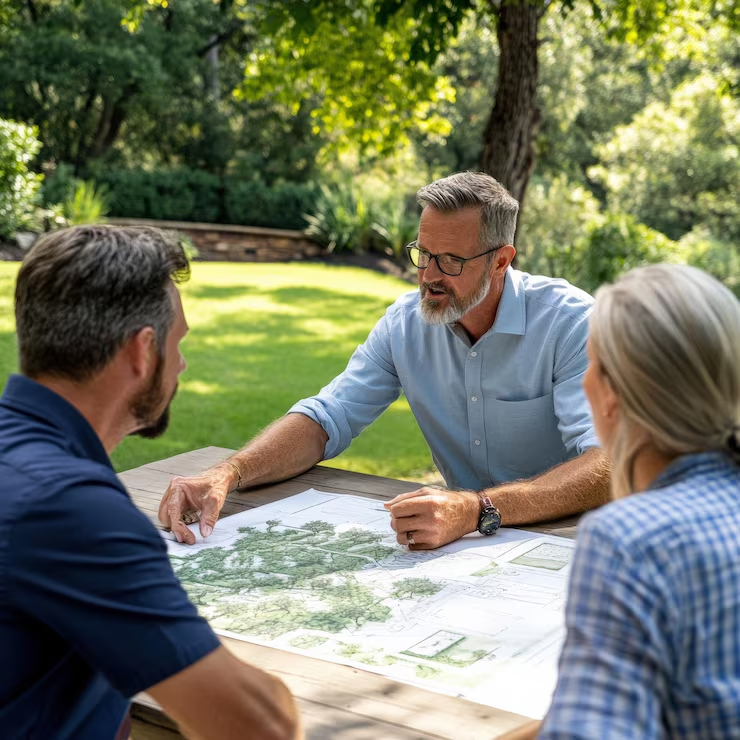
If you have a sloping block and are not quite sure which walls you might need, feel free to have a conversation with us. (No cost or obligation.) We can point you in the right direction. And make sure you don’t overspend where you don’t need to but you do spend your money on the right retaining wall for your needs. One that will last for years.
It’s a conversation you shouldn’t leave until the landscaper’s quote comes in.
If you’d like to have an obligation-free discussion with a landscape designer about your upcoming garden project, please feel free to book yours using this link – https://whytegardens.com.au/discovery-call/